














ReportModel/Framework Overview Report
Aligning Business Strategies with Data and Technology
The Key to Success in the Digital Era

Digital, AI & Data
Experience & Excellence
Development & Capacity
WHO WE SERVE
Projects, Clients & Consultants
The Key to Success in the Digital Era
In today’s world, data and technology are indispensable for effective decision-making and achieving institutional excellence. The critical question is: How do we align business strategy with data and information technology strategies? This article presents two pioneering models used to achieve this alignment: the Strategic Alignment Model (SAM) and the Amsterdam Information Model (AIM).
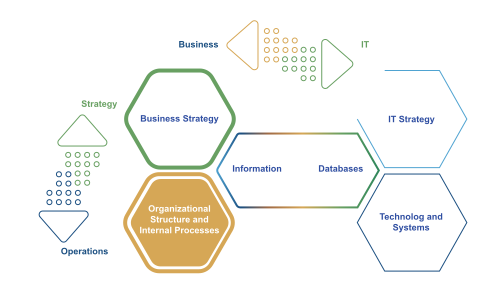
The Strategic Alignment Model (SAM), developed by Henderson and Venkatraman, is designed to create a coherent relationship between business strategies and information technology (IT) strategies. Its purpose is to ensure that data and technology are utilized in a way that supports the long-term goals of the organization.
Components of the SAM Model
How the SAM Model Works
The SAM model emphasizes that there must be alignment between these components for success. For instance, the IT strategy should be designed to support the business strategy, not just as standalone systems. Additionally, the organizational infrastructure must be capable of facilitating coordination between business and IT teams.
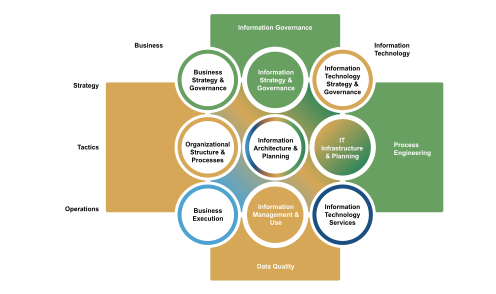
The Amsterdam Information Model (AIM), developed by Abcouwer, Maes, and Truijens, is another framework designed to connect business strategy with IT in an organization. AIM addresses how to manage information within organizations, considering the organizational structure, institutional culture, and tactical approach to enhance the strategic use of data.
Components of the AIM Model
AIM consists of a matrix with nine interconnected cells, divided into three main levels: strategy, tactics, and operations. The model places significant emphasis on data governance and quality in the context of business operations.
Relationships Between the Components
The AIM model outlines several interrelated relationships for managing data and IT:
AIM fosters communication between technical and business teams, ensuring that data strategies align with operational needs. It also strengthens data governance and quality, encouraging improvements that enhance the effectiveness of data use across the organization.
As organizations face rapid changes, those that successfully align their business strategies with data and technology will be able to lead the market, make smarter decisions, and fully capitalize on digital transformation. Does your organization apply one of these models?

Model/Framework Overview Report

Model/Framework Overview Report

Model/Framework Overview Report